"Walking Through the Market", 16 x 12 In, Oil on Panel
I am pulling out photos of figures from past trips and just going at it--both to practice the figure proportions and to think about design. Its fun to work with a bigger canvas.
Purchase this unframed painting.
Contact me if you would like to purchase a plein air frame.
Tuesday, February 8, 2011
Monday, February 7, 2011
On the Border - NFS
"On the Border", 16" x 10", Oil on Panel
On our trip to Thailand a few years ago our group had the opportunity to cross over the northern border for a day's excursion into Burma. In the Burmese border town I took a photo of this man, standing as if out of time in an area filled with both building rubble and workers. He appeared entirely self-assured and there was something so still and enigmatic about him, I wished I could have found out about him.
Sunday, February 6, 2011
Old Naxi Woman
"Old Naxi Woman", 12 x 8 In, Oil on Museum Board
This is the first figure study I did after watching Peggi's DVD on "simplified figure proportions" and it is obviously a very quick study. I don't have easy access to models so I've been pulling out photos from past trips. I have a few more still lifes from the past week, but honestly I'm so tired of still lifes maybe I'll wait until I go on a trip to post those. I'm ready for different subject matter!
Someone asked yesterday where I purchase museum board. I purchase the 100% cotton rag museum board in 32 x 40 4-ply sheets, getting the Risings brand from Talas. I buy the 25 sheet pack, and then I'm good for quite a long time. From one sheet I can get sixteen 8" x 10" panels. I usually prepare 5-8 sheets at a time. Its a good idea to have a mat cutter--I bought a Logan several years ago and it was probably the 650 Logan though I can't find a number on it.
I added more information about priming the museum boards to the last post--so if you had questions, there is more detail now on that post.
Purchase this unframed painting.
Contact me if you would like to purchase a plein air frame.
This is the first figure study I did after watching Peggi's DVD on "simplified figure proportions" and it is obviously a very quick study. I don't have easy access to models so I've been pulling out photos from past trips. I have a few more still lifes from the past week, but honestly I'm so tired of still lifes maybe I'll wait until I go on a trip to post those. I'm ready for different subject matter!
Someone asked yesterday where I purchase museum board. I purchase the 100% cotton rag museum board in 32 x 40 4-ply sheets, getting the Risings brand from Talas. I buy the 25 sheet pack, and then I'm good for quite a long time. From one sheet I can get sixteen 8" x 10" panels. I usually prepare 5-8 sheets at a time. Its a good idea to have a mat cutter--I bought a Logan several years ago and it was probably the 650 Logan though I can't find a number on it.
I added more information about priming the museum boards to the last post--so if you had questions, there is more detail now on that post.
Purchase this unframed painting.
Contact me if you would like to purchase a plein air frame.
Saturday, February 5, 2011
Still Life with Red Flowers - SOLD
"Still Life with Red Flowers", 10 x 12 In, Oil on Museum Board
You may wonder about the boards I often use for small paintings--museum board. This is a surface that I learned about back in the mid-90's from William Reese, who recently passed away. I purchase the 100% cotton rag museum board in 32 x 40 4-ply sheets, getting the Risings brand because both sides are good, unlike some other museum board that I've tried. I seal both sides of the board with Gamblin PVA Size, then apply three coats of gesso on one side with a 6" fine white roller. Since I do three coats, I try to make it fairly smooth. If you use a less fine roller, the surface may be too "pebbly" by the third coat. The surface will be slightly rough (if you use the absorbent gesso), so you can lightly sand it. Then I can cut the boards to the sizes I want to work on with my mat cutter. They are wonderfully lightweight for travel. I take a couple of pieces of foam core to tape the boards to for painting to give them stability.
Most acrylic gessos are slick once applied. Some people like to paint on a slick surface, but I prefer a more absorbent surface. The only gesso I've found to be absorbent is Liquitex Basic Gesso. I can usually find this at my local Michael's or Joanne's. I once bought the Liquitex Pro and found it to be as slick as plastic, but I have mixed small amounts of that in with the Basic to make the Basic slightly less absorbent. I have no idea about the archival results of using this type of gesso--there are big discussions about this on various networks. This discussion on Plein Air Artists is about using lead primer as a ground.
William Reese was my first plein air instructor. He studied with Sergei Bongart and was a wonderful painter. I highly recommend both of his books, and his wife, Fran, has put out a DVD with instructions about drawing parts of the horse from Bill's final days.
You may wonder about the boards I often use for small paintings--museum board. This is a surface that I learned about back in the mid-90's from William Reese, who recently passed away. I purchase the 100% cotton rag museum board in 32 x 40 4-ply sheets, getting the Risings brand because both sides are good, unlike some other museum board that I've tried. I seal both sides of the board with Gamblin PVA Size, then apply three coats of gesso on one side with a 6" fine white roller. Since I do three coats, I try to make it fairly smooth. If you use a less fine roller, the surface may be too "pebbly" by the third coat. The surface will be slightly rough (if you use the absorbent gesso), so you can lightly sand it. Then I can cut the boards to the sizes I want to work on with my mat cutter. They are wonderfully lightweight for travel. I take a couple of pieces of foam core to tape the boards to for painting to give them stability.
Most acrylic gessos are slick once applied. Some people like to paint on a slick surface, but I prefer a more absorbent surface. The only gesso I've found to be absorbent is Liquitex Basic Gesso. I can usually find this at my local Michael's or Joanne's. I once bought the Liquitex Pro and found it to be as slick as plastic, but I have mixed small amounts of that in with the Basic to make the Basic slightly less absorbent. I have no idea about the archival results of using this type of gesso--there are big discussions about this on various networks. This discussion on Plein Air Artists is about using lead primer as a ground.
William Reese was my first plein air instructor. He studied with Sergei Bongart and was a wonderful painter. I highly recommend both of his books, and his wife, Fran, has put out a DVD with instructions about drawing parts of the horse from Bill's final days.
Friday, February 4, 2011
Mug with Oranges
"Mug with Oranges", 10 x 10 In, Oil on Museum Board
I'm still experimenting with the palette knife, especially when I have a hard time focusing on the painting. The palette knife definitely focuses the mind.
Purchase this unframed painting.
Contact me if you would like to purchase a plein air frame.
I'm still experimenting with the palette knife, especially when I have a hard time focusing on the painting. The palette knife definitely focuses the mind.
Purchase this unframed painting.
Contact me if you would like to purchase a plein air frame.
Thursday, February 3, 2011
Blue Dish with Apples
"Blue Dish with Apples", 10 x 10 In, Oil on Museum Board
This is another painting done with more or less free brushstrokes. I have remembered for many years Henrich Wolfflin's Principles of Art History from my college days. It is an analytical study that I mainly remember being about the difference between the linear and painterly styles of painting--the difference between Durer and Rembrandt, for example. I recently got a copy to read again--and found it to be much more comprehensive and dense than I had remembered! But the impact that it had on my thinking as a 20 year old has stayed with me for my whole life.
Purchase this unframed painting.
Contact me if you would like to purchase a plein air frame.
This is another painting done with more or less free brushstrokes. I have remembered for many years Henrich Wolfflin's Principles of Art History from my college days. It is an analytical study that I mainly remember being about the difference between the linear and painterly styles of painting--the difference between Durer and Rembrandt, for example. I recently got a copy to read again--and found it to be much more comprehensive and dense than I had remembered! But the impact that it had on my thinking as a 20 year old has stayed with me for my whole life.
Purchase this unframed painting.
Contact me if you would like to purchase a plein air frame.
Wednesday, February 2, 2011
Enamel Pot
"Enamel Pot", 10 x 10 In, Oil on Museum Board
Sometimes I like to paint by loading the brush and just swishing it around the canvas--sort of like finger painting with a brush. It is therapeutic.
Purchase this unframed painting.
Contact me if you would like to purchase a plein air frame.
Sometimes I like to paint by loading the brush and just swishing it around the canvas--sort of like finger painting with a brush. It is therapeutic.
Purchase this unframed painting.
Contact me if you would like to purchase a plein air frame.
Tuesday, February 1, 2011
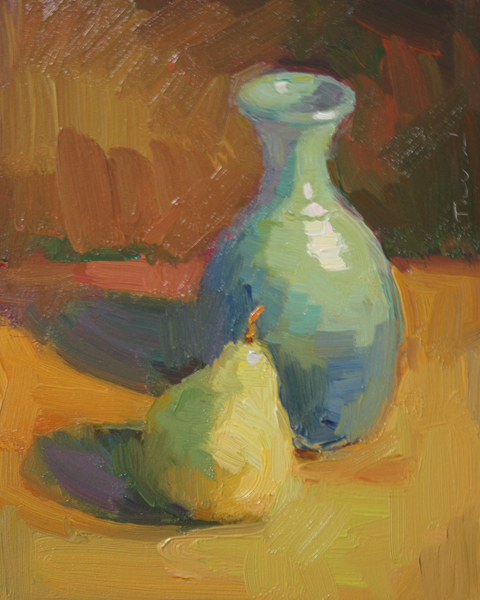
Blue Vase with Pear
"Blue Vase with Pear", 10 x 8, Oil on Museum Board
Sometimes is it good to just do a really simple composition.
Purchase this unframed painting.
Contact me if you would like to purchase a plein air frame.
Sometimes is it good to just do a really simple composition.
Purchase this unframed painting.
Contact me if you would like to purchase a plein air frame.
Subscribe to:
Posts (Atom)